
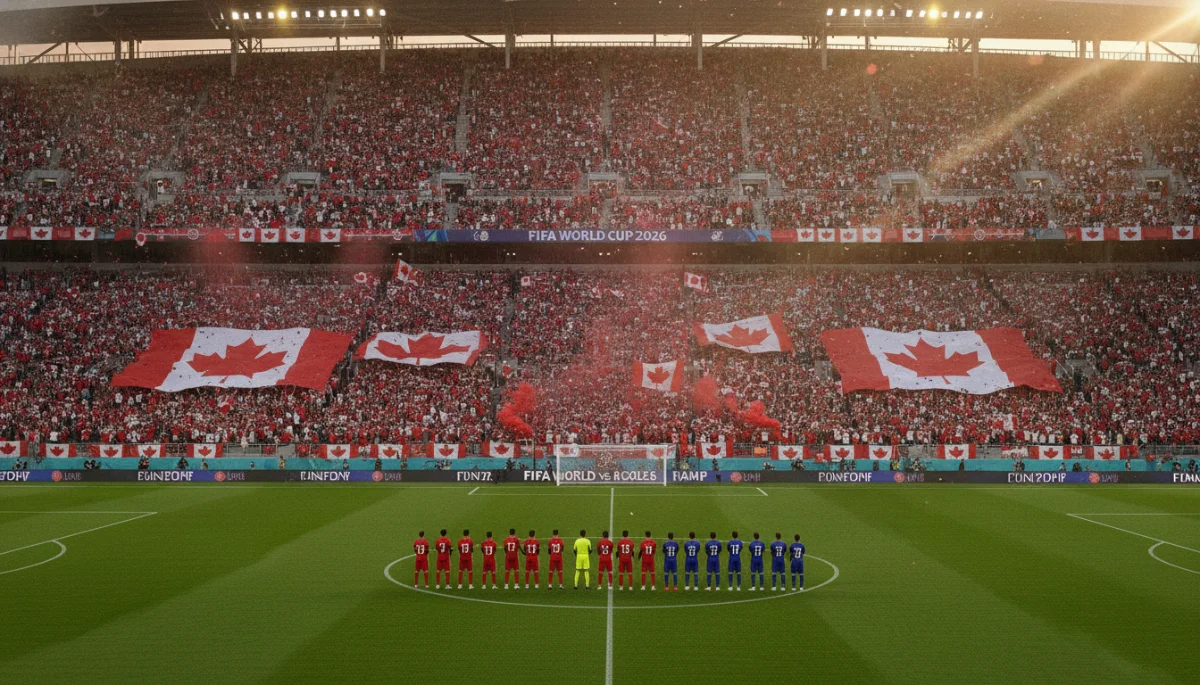
Canada’s first home World Cup match carries enormous weight, and Friday’s meeting with Bosnia and Herzegovina has all the ingredients of a tense, high-value opener. The hosts step into BMO Field with a chance to set the tone for Group B, but they will also be carrying the burden of a nation waiting for its first men’s World Cup victory.
That alone makes the night feel different from past Canadian appearances. The program’s World Cup history is short and harsh, with only three tournament berths and six losses from six matches, yet this squad arrives with more confidence, more depth, and a clearer identity than the teams that came before it. The question is not whether Canada belongs on this stage. The question is whether it can turn a landmark night into three points.
Why the hosts believe this is their moment
Jesse Marsch has given Canada a shape and a mentality that travel well. The team enters the opener on an eight-match unbeaten run, has not lost in 2026, and has stacked up six clean sheets during that stretch. Results in the final warmup window reinforced the trend: a 2-0 win over Uzbekistan followed by a 1-1 draw with the Republic of Ireland. Those are the kinds of outcomes that suggest a side arriving with structure rather than hope.
What stands out most is the balance. Canada is no longer relying only on speed in transition or a single star to solve every problem. It now looks like a team that can defend in numbers, win the ball in useful areas, and move forward quickly enough to punish mistakes. In an opening match, that blend matters because nerves often decide the first hour more than tactics do. If Canada settles early, the crowd can become a weapon instead of a weight.
The missing piece everyone will notice
The major concern is Alphonso Davies, whose hamstring injury is expected to keep him out of the opener. Any team would miss a player of that caliber, and Canada is no exception. Davies brings pace, directness, and a level of individual danger that changes how opponents defend. His absence does not remove Canada’s chance to win, but it does narrow the margin for error.
Even so, this is not a one-man attack. Jonathan David remains the most likely finishing threat and the player Bosnia must track with the greatest urgency. Ismael Koné, Stephen Eustaquio, Liam Millar, Cyle Larin, and Tajon Buchanan give Marsch a mix of control, thrust, and final-third quality. That depth is part of what makes this version of Canada different from previous generations. There are more ways to score, and more ways to adjust if the match becomes uncomfortable.
Boston? That is not the opponent here; Bosnia and Herzegovina is. Their lineup includes enough experience to make this matchup far less straightforward than the setting suggests.
Why Bosnia can make this difficult
Bosnia and Herzegovina did not reach the tournament by accident. Their route included nerve and resilience, most notably a penalty shootout win over Italy in Zenica that announced them as a team capable of surviving pressure. They also held their nerve from the spot against Wales, and that knockout-stage temperament may matter again if this game stays tight into the final half hour.
This is only Bosnia’s second World Cup, but the squad has enough familiarity to know how to slow a game down. They are unbeaten in their last eight, and they have conceded one goal or fewer in each of their last six matches. Sergej Barbarez’s side is built to be compact, stubborn, and difficult to unpick. That is not the same as being flashy, but it can be very effective against a home team that is expected to do most of the attacking.
Edin Dzeko remains the central figure, and at 40 he still gives Bosnia a proven target and a leader who understands how to manage big occasions. Stuttgart’s Ermedin Demirovic is expected to join him up front, while PSV Eindhoven’s Esmir Bajraktarevic offers pace and unpredictability in transition. Canada will have to respect the counterattack because Bosnia does not need many openings to create danger.
There is, however, a small window of optimism for the hosts. Bosnia’s final friendlies were not especially sharp, ending in a 0-0 draw with North Macedonia and a 1-1 draw with Panama. Those are not disastrous results, but they do hint at a team that may not be at full attacking rhythm yet.
The likely shape of the game
The tactical picture is easy to imagine. Canada should have the ball more often, press higher, and try to pin Bosnia back. Bosnia will likely stay organized, protect the center of the field, and wait for moments when Dzeko or Bajraktarevic can break into space. That makes the middle of the pitch crucial. If Eustaquio controls tempo and Canada can move Bosnia’s block from side to side, the home side should generate chances. If Bosnia compresses the midfield and forces Canada into rushed attacks, the match could become a grind.
That is why a low-scoring outcome feels plausible. Openers often reward patience, not ambition, and both teams have recent evidence that they can keep games under control defensively. Canada’s best path is probably to score first and make Bosnia chase. If the first goal does not arrive, the atmosphere could shift from celebratory to anxious very quickly.
The larger group context adds even more pressure. Switzerland are favored to win Group B, which turns this match into a likely battle for second place before the tournament has even fully settled. Qatar complete the group, so every point matters, but this one may matter most. A win here would give Canada not only momentum, but also breathing room in the race for a knockout spot.
The betting market reflects that tension. Canada is a modest favorite, and the most common expectation is a narrow result with few goals. A 1-0 or 2-1 home win fits the logic of the matchup, especially with Toronto’s crowd behind the hosts and Jonathan David positioned to be the difference. Still, Bosnia has already shown it can survive pressure and steal results, so a draw would not be a shock. What matters most for Canada is not style points. It is avoiding the kind of opening-night disappointment that can reshape an entire tournament.
How Canadian viewers can follow it
Canadian coverage is split across Bell Media platforms, with TSN handling English-language broadcasts and RDS carrying French-language coverage. CTV and the CTV channel on the Crave app will also carry selected matches, including Canada’s three group-stage games. For this opener, pregame coverage begins at 11 a.m. ET, and kickoff is set for 3 p.m. ET.
That schedule matters because this is not a match people will want to join late. It is the beginning of something historic, and the setting alone guarantees a full national audience. Canada has waited a long time for a World Cup match on home soil, and Friday gives the team a chance to turn that wait into something memorable.

Leave a Reply