
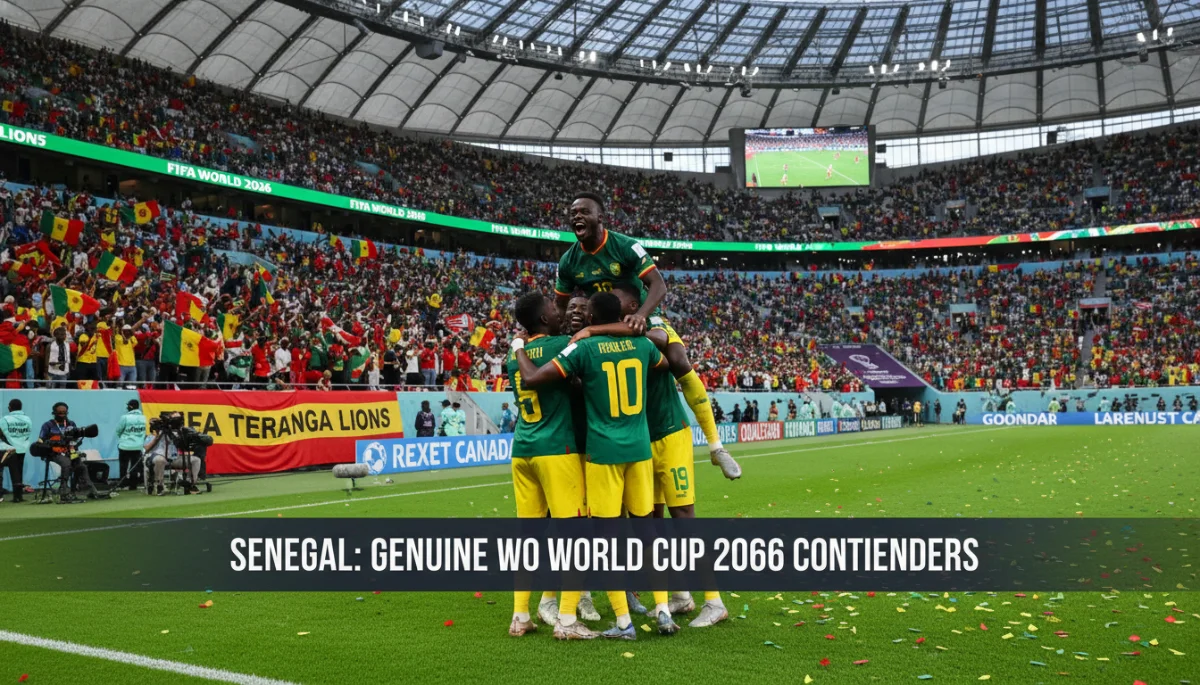
Senegal has become one of world football’s most intriguing forces because its ambition is now matched by structure, talent, and belief. Under Pape Thiaw, the team is speaking openly about winning the World Cup rather than simply surviving it, and that shift captures how far the program has come.
That confidence is why the Senegal World Cup 2026 prospects draw serious attention from fans and bettors alike. Those in Canada can bet on Senegal for the World Cup on Rexbet Canada, where the appeal is obvious: Senegal blends veteran leadership, emerging stars, and one of the most effective talent pipelines in African football.

The challenge is that the same system producing elite players also exposes deep imbalances. Senegal’s rise has been efficient for the national team, but it has not always been equally rewarding for the domestic game. The result is a success story with a complicated economic underside.
A Talent Factory Built on Precision
Senegal produces far more elite footballers than its population size would suggest, and that output is no accident. Academies such as Generation Foot, Diambars, and Dakar Sacre Coeur have created a disciplined pathway that combines coaching, schooling, nutrition, and medical support at a level that rivals far wealthier systems.
These academies are not just development centers. They are also gateways into Europe, especially through long-running partnerships with clubs that secure early access to top prospects. Generation Foot’s relationship with FC Metz is the clearest example, and it has helped launch careers for players like Sadio Mane, Ismaila Sarr, and Pape Matar Sarr.
The problem is that the financial rewards rarely stay near the source. A recent review of 13 academy-trained players who reached Senegal’s continental squads showed that their local academies initially received only about €100,000 in transfer fees, while European clubs later moved those same players for a combined €81.2 million. Across their careers, those 13 players generated more than €411 million in total transfer fees.
That gap explains why Senegal’s development model is admired and criticized at the same time. Foreign clubs profit from refining talent, while local clubs often struggle with basic funding, aging facilities, and limited visibility for the domestic league. Even the money that should return through solidarity payments can become a source of conflict when administrative systems fail to deliver what clubs are owed.
What the Diaspora Pipeline Changes
Senegal’s success is not built on academy graduates alone. The federation has also become highly effective at recruiting dual-national players from Europe before they lock in commitments elsewhere. That strategy has turned a long-standing weakness into a competitive advantage.
The process is usually deliberate and early. Young players between 16 and 19 are identified while they are still open to choosing a national side, and the federation leans on family identity, culture, and the appeal of joining a team that is genuinely competitive on the world stage. For many prospects, that combination matters more than a simple sporting pitch.
Recent examples include Ibrahim Mbaye of PSG and Mamadou Sarr of Chelsea, both of whom had represented France at youth level before aligning with Senegal. Their decisions show how the federation now competes for elite talent with confidence rather than desperation.
This approach gives Senegal more depth and flexibility, especially in tournaments where squads are tested over multiple matches. It also allows the team to pair polished European-developed players with homegrown leaders who understand the system from the inside.
Why 2026 Feels Different
Senegal’s 2026 squad has the kind of age spread that can change a tournament. Experienced players such as Idrissa Gana Gueye can anchor matches while younger additions bring pace, freshness, and tactical variety.
The emotional weight of the tournament is just as important. For Sadio Mane, Kalidou Koulibaly, and Edouard Mendy, this may be the final opportunity to define an era that has already reshaped expectations for Senegalese football. If they want a lasting legacy, North America offers the stage.
Senegal’s group will be demanding from the start. France, Norway, and Iraq create a difficult path, and the opening match against France in New Jersey could determine the tone of the entire campaign. A strong performance there would validate the idea that Senegal can compete with the world’s best, not just frustrate them.
What Must Happen Next
- Senegal must keep converting academy success into first-team stability, so the national side remains deep without draining domestic football.
- The federation needs a cleaner financial system, because local clubs cannot keep losing value while Europe captures the largest share of transfer income.
- The coaching staff must balance experience and youth carefully, since the team’s ceiling depends on using both wisely in pressure situations.
- The domestic league needs more support and visibility, because a strong national team is easier to sustain when the local base is healthier.
A Team With Real Ambition
Senegal is no longer approaching the World Cup as a feel-good outsider. It is entering as a nation that has invested in elite development, learned how to recruit intelligently, and built a roster capable of troubling anyone.
At the same time, the broader picture remains unfinished. The national team is thriving, but the ecosystem around it still needs repair. That tension is what makes Senegal such a compelling story: its greatest football success may also be exposing the parts of the system that have been left behind.

Leave a Reply