
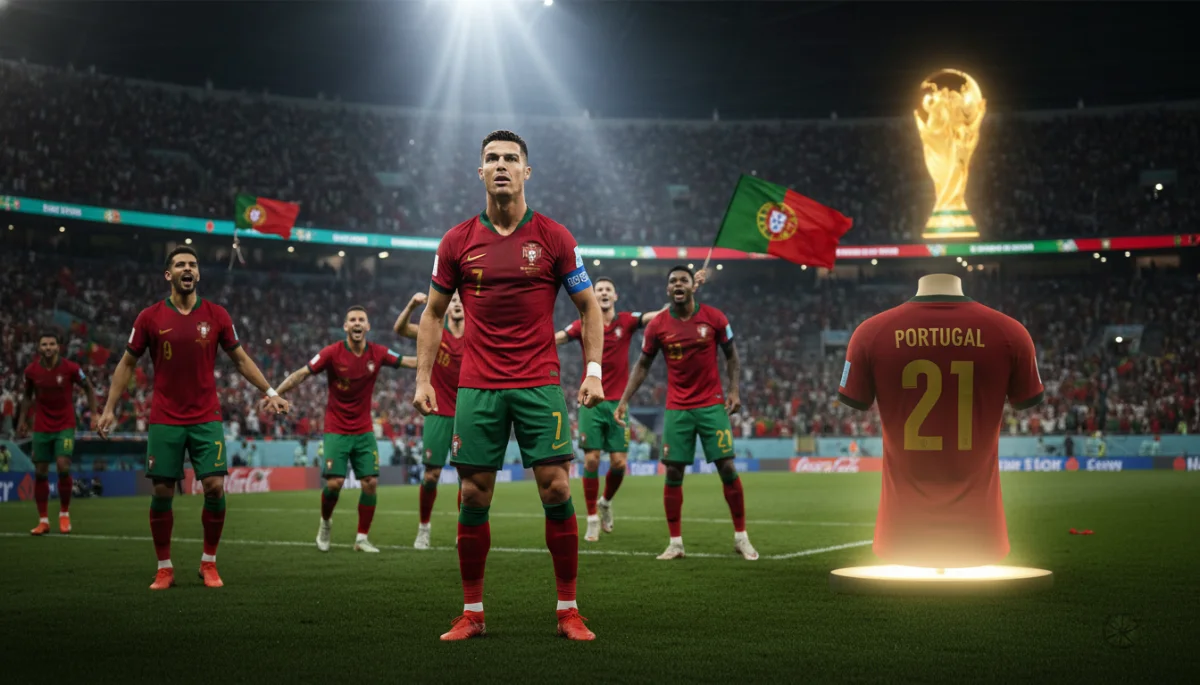
Portugal has unveiled a World Cup squad that blends star power, experience, and emotion. Cristiano Ronaldo is in the group and is once again at the center of attention, this time with the chance to make history at a sixth FIFA World Cup. At the same time, the announcement carried a powerful message of remembrance for Diogo Jota, whose memory remains woven into the team’s mission.
Ronaldo’s Next Landmark
At 41, Ronaldo is still the defining figure in Portugal’s setup. His selection is not just about name value. Roberto Martínez has made it clear that the captain still brings leadership, standards, and a competitive edge that matter in a tournament as demanding as this one.
If he appears in the tournament, Ronaldo will join a rare group of players who have featured in six World Cups. That would add another line to a career already packed with records, including the most goals in men’s international football and the most appearances at that level.
Ronaldo is also the only male player to score in five different World Cups, a mark that underscores how long he has stayed relevant on the biggest stage. Even now, Portugal still leans on his presence when the pressure rises.
The Emotional Place of Diogo Jota
The squad announcement was about more than football. Martínez spoke about Diogo Jota in a way that showed how deeply his loss continues to affect the national team. Jota died in a car crash in Spain last year at the age of 28, and his absence is still felt strongly by teammates and staff.
Portugal has chosen to honor him in a symbolic way, naming 27 players even though a World Cup roster is limited to 26. Jota is being remembered as the team’s permanent “plus one,” a gesture that turns the squad list into something more personal than procedural.
That tribute gives the group a clear emotional thread. For Portugal, this is not only a tournament campaign. It is also a way to carry Jota’s spirit forward.
A Squad Built for Balance
Portugal’s roster has depth in every area, which is one reason expectations remain high. Martínez has selected a group that can defend, control the ball, and attack in several different ways. The shape of the squad suggests flexibility rather than dependence on one style.
The team also draws strength from players spread across major European clubs, along with Ronaldo and João Félix now at Al Nassr. That mix of backgrounds gives Portugal a broad range of experience and tactical options.
Goalkeeping Options
Portugal’s goalkeeping unit is led by Diogo Costa, with José Sá and Rui Silva also included. Ricardo Velho has been named as a fourth option and would likely only become involved if injuries change the picture. It is a practical group, with Costa expected to hold the main role.
Defensive Choices
The back line includes Rúben Dias, João Cancelo, Diogo Dalot, Nuno Mendes, Nélson Semedo, Matheus Nunes, Gonçalo Inácio, Renato Veiga, and Tomás Araújo. Dias should anchor the defense, while Cancelo, Dalot, and Mendes add the kind of width and passing range that can change a match from the back.
Midfield Control
Portugal’s midfield is one of the team’s strongest areas. Bruno Fernandes and Bernardo Silva bring experience and creativity. Vitinha, João Neves, Rúben Neves, and Samú Costa add energy, control, and balance. This group gives Martínez several ways to manage possession and create chances.
That depth should help Portugal avoid becoming predictable. In tournament football, the ability to adjust the middle of the field often decides whether a team advances or goes home.
Attacking Firepower
Portugal’s forward group is loaded with variety. Ronaldo remains the main reference point, but the supporting cast gives the team pace, movement, and direct threat. Rafael Leão, João Félix, Gonçalo Ramos, Pedro Neto, Francisco Conceição, Gonçalo Guedes, and Francisco Trincão all offer different qualities.
That variety matters because Portugal can approach games in multiple ways. It can play through Ronaldo, use Ramos as a central striker, or stretch defenses with wide runners who attack space quickly.
Group Stage Road Map
Portugal has been placed in Group K with Congo, Uzbekistan, and Colombia. The campaign begins against Congo on June 17 in Houston, and the buildup starts much earlier with the squad gathering on June 1.
The preparation schedule is straightforward. Portugal faces Chile on June 6 and Nigeria on June 10 before traveling to the United States on June 12. Those matches should give Martínez a chance to test combinations and settle on his preferred lineup before the tournament starts in earnest.
For a team with serious ambitions, the warm-up period matters. The coach will want rhythm, health, and clarity before the first competitive whistle.
Why Portugal Believes It Can Go Deep
Martínez has resisted calling Portugal the outright favorite, and that caution makes sense. He has suggested that the favorite label usually belongs to teams that have already won the World Cup. Portugal has not, but it has enough quality to believe it can challenge anyone.
Recent results support that confidence. Portugal won the 2025 Nations League by beating Germany in the semifinal and Spain in the final. Those results showed that the team can handle elite opponents when the stakes are high.
Several factors strengthen the case for a serious run:
- A deep roster with quality in every line
- Ronaldo’s leadership and competitive standard
- Creativity from Bruno Fernandes, Bernardo Silva, and Vitinha
- Explosive attacking options such as Rafael Leão and Pedro Neto
- Strong defensive leadership from Rúben Dias
- Confidence built by recent tournament success
- Extra motivation tied to Diogo Jota’s memory
The Bigger Picture
This World Cup could become one of the most important chapters in modern Portuguese football. For Ronaldo, it may be the final major international stage of his career. For Martínez, it is a chance to prove that Portugal’s talent can be shaped into a team capable of winning the sport’s biggest prize.
For supporters, the appeal is obvious. Portugal enters the tournament with talent, depth, and a clear sense of purpose. It also carries a tribute that gives every match added meaning. If the squad finds the right balance, it could become one of the most difficult teams to eliminate.
And if Ronaldo keeps adding to his legacy while the group plays for Jota as well, Portugal’s campaign may become memorable for reasons far beyond the final score.

Leave a Reply