
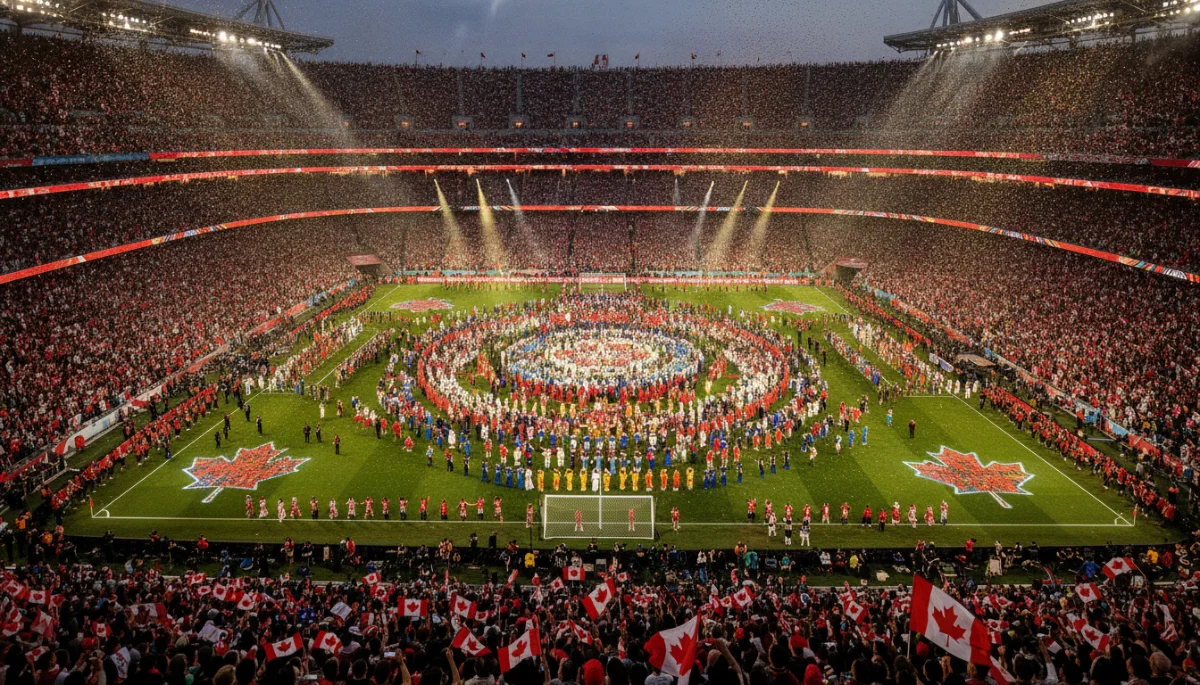
The 2026 FIFA World Cup is opening with a first for Canada, and the country’s role in the tournament is already historic. Toronto will host the Canadian opening ceremony before the men’s national team plays its first-ever World Cup match on home soil, turning the event into a milestone rather than a routine kickoff.
The competition itself is enormous: 104 matches, 16 host cities, and three co-host nations sharing the spotlight from June 11 through the final on July 19 in New York. Canada is not hosting the tournament alone, but this is still the country’s first time welcoming the world’s biggest soccer event.
Toronto takes center stage
Canada’s ceremony is scheduled for June 12 at Toronto Stadium, beginning at 1:30 p.m. local time, which is 17:30 GMT. The show is expected to run for about 13 minutes and is built around the idea of a cultural mosaic, a theme meant to reflect the country’s diversity through music, performance, and a countdown that moves “from coast to coast to coast.”
The planned lineup highlights a mix of Canadian and international performers. The Canadian names expected to appear include Alanis Morissette, Alessia Cara, Jessie Reyez, Michael Bublé, and William Prince, while Elyanna, Nora Fatehi, Sanjoy, and Vegedream add global reach to the production. FIFA President Gianni Infantino described the ceremony as “a powerful reflection of Canada’s identity,” framing it as a moment of pride and unity.
Toronto’s celebration also arrives with practical importance. It is not only a symbolic opening; it is the lead-in to a major sporting night that has been years in the making for Canadian fans.
What happens across the three hosts
The Canadian program is part of a larger three-country opening sequence tied together by the same broader message: football as a force that crosses borders. The ceremonies are being produced by Marco Balich, who has worked on several Olympic opening ceremonies, and each host nation is using a distinct visual style to represent its own identity.
Mexico’s version leans on traditional paper art and Indigenous performance, the United States is leaning into a bright, high-energy presentation, and Canada’s show is centered on the idea of a national mosaic. The three ceremonies are timed to begin 90 minutes before each host country’s opening match, creating a coordinated start to the tournament rather than three separate events.
| Host nation | Opening date | Theme or style | Opening match timing |
|---|---|---|---|
| Mexico | June 11 | Indigenous and folkloric performance, paper art influence | 90 minutes before Mexico vs. South Africa |
| Canada | June 12 | Cultural mosaic and coast-to-coast-to-coast countdown | 90 minutes before Canada’s opening match |
| United States | June 12 | Bright, polished, high-gloss presentation | 90 minutes before the U.S. opener |
The first ceremony in the sequence belongs to Mexico City, where the opening show begins at Mexico City Stadium, formerly Estadio Azteca, before Mexico meets South Africa. That production is expected to be the longest of the three at roughly 16 and a half minutes and will feature performers including Shakira, Alejandro Fernández, J Balvin, Maná, and Tyla. Officials in the capital have also declared June 11 a public holiday, with schools closed and remote work encouraged.
The U.S. ceremony follows later on June 12 at Los Angeles Stadium, just before the American team faces Paraguay. That event is expected to include Katy Perry, Future, Anitta, LISA, Rema, and Tyla, adding another large-scale entertainment layer to the opening stretch of the tournament. A day that begins in Mexico City will therefore end in Los Angeles, with Toronto fitting into the middle of the global rollout.
A match that gives the ceremony real weight
Canada’s opening ceremony is especially meaningful because it leads directly into the men’s national team’s match against Bosnia and Herzegovina. For the first time in the program’s history, Canada will play a World Cup match on home soil, and the timing gives the occasion a rare emotional charge.
The kickoff is set for 3 p.m. local time, or 19:00 GMT, after the pre-match formalities and warmups. The home crowd is expected to create a strong atmosphere, especially given how long supporters have waited for a moment like this. The team’s recent rise has made the fixture feel less like a ceremonial appearance and more like a genuine sporting landmark.
For many fans, the significance goes beyond the result. The ceremony and the match together form a national debut of sorts, with Toronto acting as the stage for Canada’s arrival at football’s largest event.
How viewers can follow the opening days
In Canada, the ceremonies and matches will be available on CTV and TSN, with French-language coverage on RDS. Viewers in the United States can watch on FOX and FS1, with additional coverage on the free streaming service Tubi, while audiences in the United Kingdom can follow along through the BBC and ITV.
As the first week unfolds, the opening ceremonies will move from Mexico on June 11 to Canada and the United States on June 12. The format gives fans a rare chance to experience the tournament as a connected international event, with each host country adding its own character while contributing to one larger celebration.
Toronto’s ceremony is therefore more than an artistic prelude. It is the point where Canadian football, national identity, and a once-in-a-generation tournament come together in front of a home crowd.

Leave a Reply