
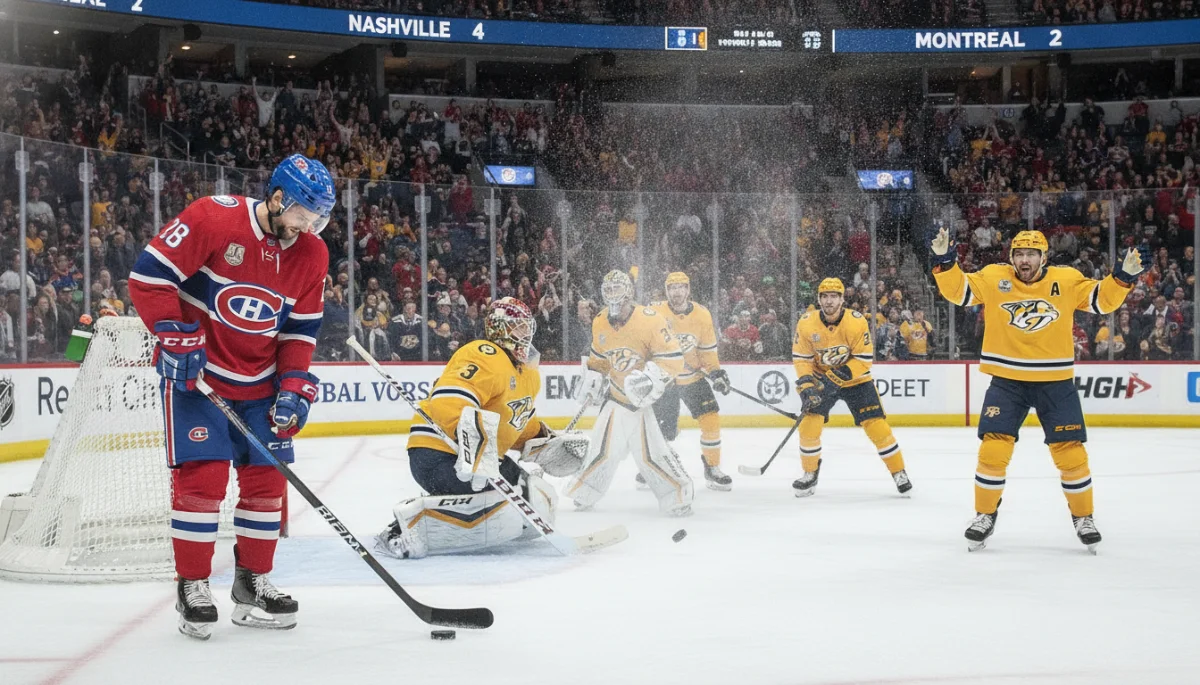
The Montreal Canadiens appeared to have Thursday’s game under control. They established a 2-0 advantage at Bell Centre, dictated play for long stretches and created enough offensive pressure to make Nashville look uncomfortable.
That control never became separation. The Predators stayed within reach, received outstanding work from Juuse Saros and punished Montreal when the Canadiens gave them power-play opportunities. Nashville eventually scored five consecutive goals to complete a 5-2 comeback win.
The result left Montreal with a 1-2-1 record and a three-game winless streak. The final score suggested a lopsided defeat, but the game was decided by a handful of missed chances, untimely penalties and a dramatic swing late in the second period.
Montreal Built the Right Start but Not a Safe Lead
Montreal’s opening advantage came from the kind of attacking hockey the team wants to play. The Canadiens pressured Nashville’s defense, kept the puck in the offensive zone and forced the Predators to defend around their own crease.
Nick Suzuki opened the scoring 3:12 into the second period during four-on-four play. He found a loose puck in front of the net and slipped a backhand shot past Saros for his third goal of the season.
Alex Newhook added another goal at the 8:50 mark. Josh Anderson created the chance with a feed after Montreal sustained pressure in Nashville’s zone, and Newhook finished to make the score 2-0.
At that stage, the Canadiens had every reason to believe they could take command. The building was energized, Nashville was struggling to produce sustained offense and Montreal was winning the territorial battle.
The problem was that the Canadiens stopped the game from becoming more difficult for Nashville. Their pressure produced chances, but not enough goals. Against an experienced goaltender such as Saros, leaving the door open can be dangerous.
Saros Kept the Predators Alive
Saros was the central reason Nashville remained within striking distance. He made 32 saves on 34 Montreal shots and repeatedly denied the Canadiens when they threatened to extend their lead.
His performance mattered because Montreal’s early dominance was real. The Canadiens were not simply firing harmless shots from the perimeter; they generated pressure and found dangerous areas. Saros prevented those sequences from turning into the three- or four-goal cushion Montreal needed.
The most important stop came in the third period. With roughly eight minutes remaining and the score tied, Anderson broke in alone and tried to restore Montreal’s lead. Saros answered with a left-pad save.
A successful finish would have changed the game. Montreal would have moved ahead 3-2, while Nashville would have faced another difficult climb. Instead, the Predators survived the chance and soon received the power play that produced the go-ahead goal.
That sequence captured the night’s difference between the teams. Montreal created opportunities but could not complete them. Nashville relied on Saros until its own decisive moments arrived.
A Two-Goal Swing Before Intermission Changed the Mood
Nashville’s comeback began during the final five minutes of the second period. Alexander Kerfoot redirected a point shot past Jacob Fowler with 4:54 left, cutting the Canadiens’ lead to 2-1.
The goal gave the Predators momentum, but Montreal still had a chance to reach the intermission with an advantage. That opportunity disappeared with only 32 seconds remaining in the period.
Matthew Wood scored on the power play to tie the game at 2-2. Instead of protecting a two-goal lead, Montreal entered the third period level with an opponent that had suddenly regained belief.
Late-period goals carry extra weight because they do more than alter the score. They change the emotional balance of the game and eliminate the chance for the leading team to use the intermission to reinforce its control.
Montreal had owned much of the night before Kerfoot’s goal. By the time the second period ended, Nashville had transformed the contest into a one-period race.
Special Teams Turned Pressure Into Punishment
Power-play execution ultimately separated the Predators from the Canadiens. Nashville scored twice with the man advantage, including Wood’s tying goal and Ryan O’Reilly’s late winner.
With the game tied late in regulation, Mike Matheson was called for tripping Steven Stamkos. Montreal could not afford another defensive breakdown or penalty at that stage, but Nashville took full advantage.
At 16:44 of the third period, Roman Josi sent the puck toward the net, and O’Reilly redirected it past Fowler to give Nashville its first lead of the evening with 3:16 remaining.
The goal was especially damaging because Montreal had not been overwhelmed at five-on-five. The Canadiens were still within one goal of victory, but the penalty handed Nashville the type of opportunity it had been waiting for.
Montreal’s own power play did not produce a comparable answer. In a tight game where Saros was making difficult saves, the Canadiens needed their special teams to create a breakthrough. Instead, Nashville’s power play supplied the game’s two most important goals.
Fowler Was Put in a Difficult Situation
Jacob Fowler made his first start of the season after Samuel Montembeault suffered a lower-body injury during Wednesday’s practice. Montreal recalled Fowler from the Laval Rocket, placing the 21-year-old into an important game on short notice.
Fowler stopped 15 shots, while three goals reached him before Montreal pulled him for an extra attacker. Nashville then added two empty-net goals through Adam Edstrom, producing the final 5-2 margin.
That distinction matters when assessing the goaltender’s performance. The scoreboard credited Nashville with five goals, but Fowler allowed three while defending the net. He also faced significant pressure during Nashville’s power-play chances.
Fowler may still have preferred a few plays back, but blaming him for the defeat would overlook the larger issues. Montreal failed to protect its lead, gave Nashville crucial special-teams chances and missed the opportunity to retake control in the third period.
His previous NHL experience should help if he receives another start. Fowler appeared in 17 games last season, recording a 9-6-2 record, a 2.43 goals-against average and a .908 save percentage. Still, an extended absence for Montembeault would force Montreal to depend on Fowler earlier and more heavily than expected.
The Score Hides How Competitive the Game Was
Edstrom’s two empty-net goals changed the appearance of the result. Before those late insurance markers, Nashville led by only one goal, and Montreal remained close to earning at least a point.
That does not make the loss harmless. The Canadiens had a favorable game script and failed to finish it. They held a 2-0 lead, created more pressure in important stretches and had a clean chance to go ahead again before O’Reilly scored.
The concern is therefore less about being outplayed for 60 minutes and more about failing to manage the moments that decide close NHL games. A team can control possession and still lose if it does not finish chances, defend with discipline and respond after momentum shifts.
Montreal’s performance contained encouraging elements, especially the first-half pressure and the production from Suzuki and Newhook. But the Canadiens must convert those positive stretches into results rather than allowing opponents to remain close enough for one save, one penalty or one deflection to change the outcome.
Detroit Provides an Immediate Test
The Canadiens have little time to dwell on the defeat because the Detroit Red Wings are scheduled to visit Bell Centre on Saturday. That matchup gives Montreal a chance to correct the same issues immediately.
Montreal needs to make stronger use of early advantages. A 2-0 lead can disappear quickly, particularly when the opposing goaltender is keeping the game manageable. The Canadiens must attack for the third goal instead of allowing pressure to become empty possession.
Discipline is just as important. Nashville’s tying and winning goals came on the power play, and Montreal cannot continue giving opponents high-value opportunities late in close games.
The team also has to help whichever goaltender starts. Cleaner defensive coverage, fewer penalties, better control of rebounds and less traffic around the crease would reduce the burden on Fowler or any replacement for Montembeault.
Suzuki will remain central to that response. His early-season scoring has already reached three goals, and his willingness to attack the area around the net provided one of Montreal’s brightest moments against Nashville.
Thursday’s defeat was frustrating because the Canadiens demonstrated enough quality to win. The next step is learning how to preserve control after gaining it. If Montreal finishes more of its chances and avoids handing away critical power plays, the team can turn a promising performance into the kind of result it missed against Nashville.

Leave a Reply