
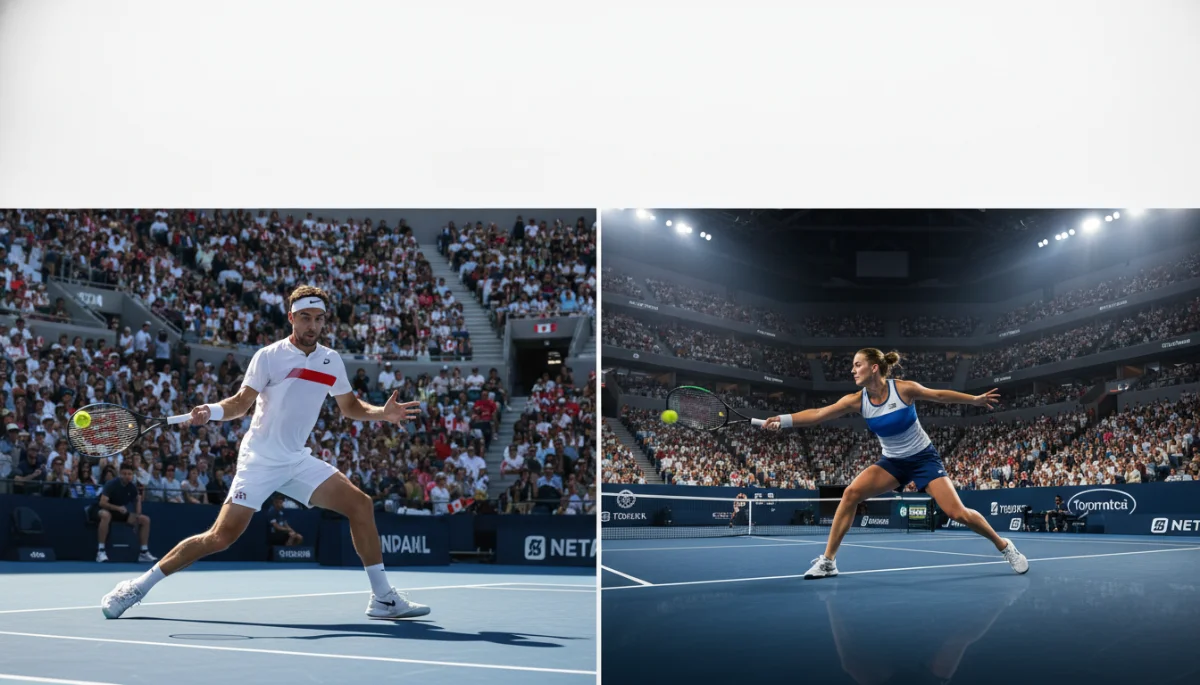
The 2026 National Bank Open is headed into a decisive stretch, with the round of 16 set to shape both draws and sharpen the title picture. Montreal has turned unpredictable on the men’s side, while Toronto has largely held to form among the leading women.
By the end of the weekend, only eight men and eight women will remain in the hunt. That makes Saturday, August 8, and Sunday, August 9, a crucial checkpoint for contenders, dark horses, and Canadian hopes alike.
What happens next matters because the early rounds have already changed the tone of the event. Several top seeds have fallen, some favorites have survived difficult tests, and a few younger players have suddenly found themselves in the spotlight.
- Two cities, two different tournament moods
- Montreal has become an open door for new names
- Why Shelton still looks like the man to beat
- Young attackers are using the chaos to their advantage
- Toronto’s top women have mostly stayed on script
- Gauff, Pegula, and Andreeva all bring different threats
- All eyes remain on Leylah Fernandez
- How to follow the tournament and what comes next
Two cities, two different tournament moods
Montreal and Toronto enter the weekend with very different storylines. The men’s field in Montreal has been shaken by major upsets and a high number of early exits, creating a draw that now looks far more open than anyone expected before the first ball was struck. Toronto, by contrast, has been steadier, with the women’s bracket still led by many of the names expected to contend for the trophy.
The schedule is spread over two days, and the order of play can still shift depending on how long earlier matches run. Day sessions in Montreal begin at 12:30 p.m., while evening sessions start at 6 p.m. Toronto follows a similar rhythm, with 12:30 p.m. starts during the day and 7 p.m. starts at night. That structure should keep the action moving from one marquee match to the next.
Fans should also expect the usual tournament-day uncertainty around exact match timing. With the length of previous matches and weather always capable of affecting the slate, the official order of play remains the safest guide.
Montreal has become an open door for new names
The men’s draw lost a remarkable amount of star power almost immediately. Alexander Zverev, Daniil Medvedev, Taylor Fritz, and Andrey Rublev all went out in their opening matches, and Félix Auger-Aliassime was forced to withdraw because of a back injury. That left the bracket stripped of several of its biggest expected threats before the tournament had even settled in.
In practical terms, that has transformed Montreal into a place where momentum may matter more than ranking. A player who survives the early chaos now has a real chance to build a deep run, especially if confidence is growing with each round.
Ben Shelton remains one of the central figures in that conversation. The defending champion opened with a 6-3, 7-5 win over Jenson Brooksby, and his serve continues to be one of the most difficult weapons to handle on the quick hard courts at the Stade IGA. His style is direct, aggressive, and built to punish hesitation.
Casper Ruud is also firmly in the mix. He eased past Juan Manuel Cerúndolo 6-1, 6-2 in his first match and arrives with the kind of professionalism that can be useful when a draw becomes volatile. Although he is better known for his results on clay, he has collected enough hard-court experience to make this kind of opportunity count.
Why Shelton still looks like the man to beat
Shelton’s defending-champion status adds another layer to the weekend. He is no longer viewed only as a dangerous young player with upside; he is now a proven Masters 1000 winner with the kind of résumé that brings higher expectations.
His 2025 title run showed that his serve, forehand, and energy can overwhelm established opponents when he is landing first serves and keeping points on his terms. That profile remains dangerous in a field that has suddenly thinned around him.
Still, the path is not automatic. Shelton can run into trouble when he tries to finish points too quickly and allows errors to pile up. If he stays patient enough to avoid those dips, the door to another deep run looks wide open.
Ruud, Shelton, and a handful of remaining contenders all have a realistic shot at reaching the last eight, but Shelton’s combination of title pedigree and explosive shot-making gives him a slight edge in a bracket that now feels unusually fluid.
Young attackers are using the chaos to their advantage
Several younger players have already taken advantage of the disrupted draw. João Fonseca delivered one of the standout results of the event by eliminating Stefanos Tsitsipas in a competitive match. The Brazilian’s power is obvious, but so is his comfort in big atmospheres, and that combination makes him a serious threat whenever the pace of play suits him.
Arthur Fils has also put himself in position to make noise. He needed three sets to get past Zachary Svajda, but his athleticism and willingness to take control from the baseline fit the conditions in Montreal well. If he keeps serving well, he has the tools to challenge anyone still left in the section.
Tallon Griekspoor may have made the loudest statement of all. His comeback win over Zverev, a 6-7, 6-2, 6-4 victory, was not just an upset; it was a message that he can handle pressure against the very top of the draw. That kind of win often changes how a player approaches the rest of the week.
In an event where several favorites have disappeared, these younger contenders are no longer playing just for respect. They are playing for a legitimate chance at a breakthrough.
Toronto’s top women have mostly stayed on script
The women’s draw in Toronto has been far less chaotic, at least through the opening rounds. Aryna Sabalenka, Elena Rybakina, Jessica Pegula, Coco Gauff, and Mirra Andreeva all advanced, preserving the high-end quality that makes this side of the tournament so compelling.
Sabalenka remains the player everyone else is chasing. The world No. 1 opened with a 6-3, 6-3 win over Moyuka Uchijima, extending her winning streak on hard courts to 13 matches. Her power game translates cleanly to Toronto’s faster conditions, and a strong weekend would help her protect her grip on the top ranking.
Rybakina, the No. 2 seed, had to work harder. She outlasted Daria Kasatkina 6-3, 5-7, 6-4 after more than two and a half hours, finishing with 58 winners and 58 unforced errors. That split tells the story of her game at the moment: devastating when locked in, but vulnerable if the margin disappears.
Even with the inconsistency, Rybakina remains one of the most dangerous players in the draw. If her serve is functioning well, she can take control of a match very quickly.
Gauff, Pegula, and Andreeva all bring different threats
Coco Gauff began with a 6-2, 7-5 win over qualifier Kayla Day, and while the match was not always smooth, her speed and defense proved decisive in the biggest moments. Few players can recover points as quickly as Gauff when rallies start to stretch, and that ability keeps her in every match she plays.
Jessica Pegula, who has already won this event twice, had the toughest path of the group early on. After dropping the first set against Magdalena Frech, she turned the match around and won 3-6, 6-3, 6-1 by taking eight of the final nine games. Her record in Canada matters, because she knows how to handle the conditions, the crowd, and the weekly grind better than almost anyone in the field.
Mirra Andreeva may have produced the most convincing performance of them all. The French Open champion swept past former world No. 1 Karolina Pliskova 6-0, 6-2 in just 54 minutes, showing a level of maturity well beyond her age. At 19, she already reads the court well, defends with discipline, and changes pace without losing control of the point.
Andreeva’s quick adjustment to hard courts sends a clear warning to the rest of the draw. She may be young, but she is not waiting for a future arrival; she is already competing like a player who belongs deep in events like this.
All eyes remain on Leylah Fernandez
For Canadian fans, Leylah Fernandez now carries the biggest remaining homegrown storyline. She became the last Canadian standing in singles after beating Renata Zarazúa 6-2, 6-2 in front of a supportive Toronto crowd.
The match was controlled from the start. Fernandez broke serve repeatedly, protected her own delivery well, and kept the pressure on until the finish. She was broken only once and created five service breaks of her own, which reflected both her aggression and her ability to stay on the front foot.
Her next challenge is Elise Mertens, an experienced opponent who can extend rallies and make points feel longer than Fernandez may want. That matchup will reward the player who takes the initiative earliest.
If Fernandez can strike the ball cleanly and use her forehand to open the court, she has a real chance to reach the weekend. That would keep the local interest alive in a tournament where the Canadian men have already fallen short or been stopped by injury.
How to follow the tournament and what comes next
Sportsnet and TVA Sports are carrying the National Bank Open in Canada, with coverage split between the Montreal and Toronto events. Their digital platforms also provide access for viewers who want to follow the action away from a television screen.
The next two days should do more than fill the quarterfinal bracket. They will also reveal whether Montreal’s upheaval leads to another surprise champion or whether a player like Shelton can steady the draw long enough to defend a title. In Toronto, the question is whether the top women continue to separate themselves or whether the field tightens once the pressure rises.
For now, the tournament feels balanced between order and chaos. Toronto has the look of a heavyweight showdown waiting to happen, while Montreal still carries the energy of a bracket that any confident player can seize. That contrast is exactly what makes the weekend so important.
If the round of 16 delivers the kind of results the first few rounds have already promised, the National Bank Open could move into its final stages with even more uncertainty, bigger storylines, and a stronger sense that anything is still possible.

Leave a Reply