
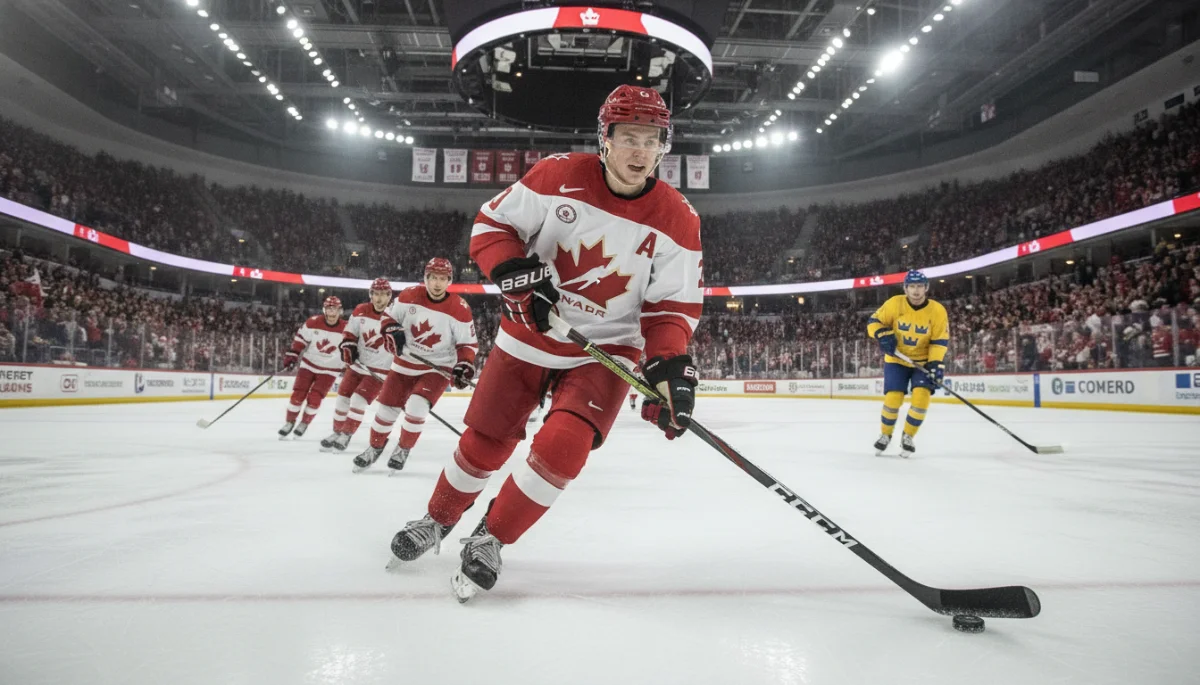
Canada has already done the most important early job at the Hlinka Gretzky Cup: it locked up a semifinal berth before its final Group A game. With two dominant wins in the books, the host team now turns its attention to the bigger target waiting later in the week.
The last preliminary test comes Wednesday, August 5, against Sweden at Rogers Place in Edmonton. Puck drop is set for 5 p.m. Mountain Time and 7 p.m. Eastern Time, and while the result will not change Canada’s place in the standings, it still carries real value.
A Strong Start Has Put Canada in Control
Canada opened the tournament with a 7-3 victory over Switzerland, a game that showed how quickly its attack can overwhelm opponents. Five goals in the first period set the tone, and the Canadians finished with a commanding 48-25 edge in shots.
The scoring was spread across the lineup, which is exactly what makes this group so difficult to defend. Liam Pue scored twice, Brock England added two of his own, and Camryn Warren, Ryerson Edgar and Benjamin Veitch also found the net. England’s second goal came shorthanded, giving the performance a little extra punch.
The second game looked even more one-sided. Canada beat Slovakia 6-1 and once again controlled the pace from start to finish.
- Kayden Stroeder scored twice and gave the offense another finishing threat.
- Landon DuPont joined the scoring, reinforcing Canada’s depth from the back end.
- Warren, Edgar and Pue also scored, continuing the balanced production.
- Canada fired 48 shots and limited Slovakia to just 13.
- Leif Oaten turned aside 12 of 13 shots in goal.
After two games, Pue, Edgar and Warren each had four points, while Maddox Schultz had collected four assists. The early numbers suggest this roster is not leaning on one line or one star to carry the load.
Why Sweden Still Matters
Even with first place already secured in Group A, the matchup with Sweden is far from meaningless. It is a chance for Canada to stay sharp, protect momentum and face a team that arrives with something to play for.
Sweden opened with a 4-3 win over Slovakia before dropping a wild 7-6 contest against Switzerland. That leaves the Swedes needing a strong finish to improve their semifinal hopes.
Canada also saw Sweden earlier in its preparation, winning 3-1 in a pre-tournament meeting. That result offers a useful reference point, but the group-stage version should provide a better measure of how the teams compare when the games matter.
Sweden has proven it can score. Dorian Eklund Aspe entered the game with four points, while Oliver Sundberg and Milan Sundstrom each had two goals through two appearances. That offensive profile gives the matchup a little extra edge, even if Canada is not under elimination pressure.
For head coach Ryan Oulahen, the game also offers a practical final rehearsal. He can evaluate line combinations, manage minutes and get his team ready for the higher tension that comes with knockout hockey. Oulahen was part of Canada’s staff during the 2024 title run in Edmonton, and now he leads the group himself.
The Knockout Path Is Still Wide Open
By winning Group A, Canada will move into Friday’s semifinal against the second-place team from Group B. The tournament format is straightforward: Group A’s winner faces Group B’s runner-up, and Group B’s winner meets Group A’s second-place team. The semifinal winners then advance to Saturday’s gold-medal game, while the losers play for bronze.
The exact opponent is still undecided. The United States sat first in Group B after two games, while Czechia and Finland were tied behind them with three points each. Germany had not yet earned a point, which means the final order would remain in flux until the rest of the preliminary schedule is complete.
That uncertainty does not reduce the importance of Canada’s own performance. A good finish against Sweden would help maintain rhythm, confidence and structure before the tournament shifts into single-elimination pressure.
Canada’s group-stage success has created room to breathe, but the real test begins when one bad period can end a title run.
The lesson from last year is easy to remember. Canada went unbeaten in the 2025 preliminary round before falling 4-3 to the United States in a semifinal shootout. The team bounced back to defeat Finland for bronze, but the loss ended its chance at another championship.
What a Home-Ice Title Would Mean
Canada’s history in the summer under-18 event explains why expectations are always high. The program has won 25 of the 34 gold medals awarded since the tournament began in 1991, including dominant streaks of seven straight titles from 1996 through 2002 and eight in a row from 2008 through 2015.
The pressure rises again when the event is held in Alberta. Before this year, Canada had captured gold in all three previous Alberta-hosted editions: Edmonton and Red Deer in 2018, Red Deer in 2022 and Edmonton in 2024. That most recent home win came with a 2-1 victory over Czechia in the gold-medal game at Rogers Place.
Another championship would keep that provincial streak alive and deliver a 26th summer under-18 title. For a program with Canada’s track record, that is the standard rather than the ceiling.
The Players Drawing the Most Attention
The Hlinka Gretzky Cup is also a show for prospects who are starting to build their reputations ahead of future draft seasons. Because the event arrives before major club and school conflicts, teams can bring together many of their best available under-18 players.
That makes the medal round especially interesting for Canadian fans, who get an early look at names that could soon become much more familiar.
- Landon DuPont has been one of the most closely watched players on the roster.
- Liam Pue has given Canada a consistent finishing touch.
- Camryn Warren has added timely offense in multiple games.
- Ryerson Edgar has joined the scoring in key spots.
- Maddox Schultz has created chances with his passing.
- Kayden Stroeder has shown the ability to produce when chances open up.
Those players will now move into the tournament’s most demanding stage. A semifinal is a different kind of test, and it often reveals which prospects can handle pressure rather than just open-ice skill.
The final preliminary game against Sweden may not decide Canada’s fate, but it still serves a purpose. It is the last chance to sharpen habits before the medal round, where pace, discipline and composure matter even more.
Canada has already proven it belongs among the favorites. The remaining question is whether this group can turn a fast start into a home-ice finish worthy of the program’s history.

Leave a Reply